
Table of Contents
Toggle1959 Tamil Nadu Language War: How a Historic Protest Shaped India’s Language Politics
Chennai (then Madras), 1959 Long before the more widely remembered 1965 anti Hindi protests, Tamil Nadu had already entered a decisive phase of resistance against what many saw as the forced imposition of Hindi. The events of 1959, often called the Tamil Nadu Language War, marked a turning point in the relationship between language, identity, and federal politics in India. What began as protests led by Dravidian parties soon grew into a mass movement that would permanently alter India’s language policy.
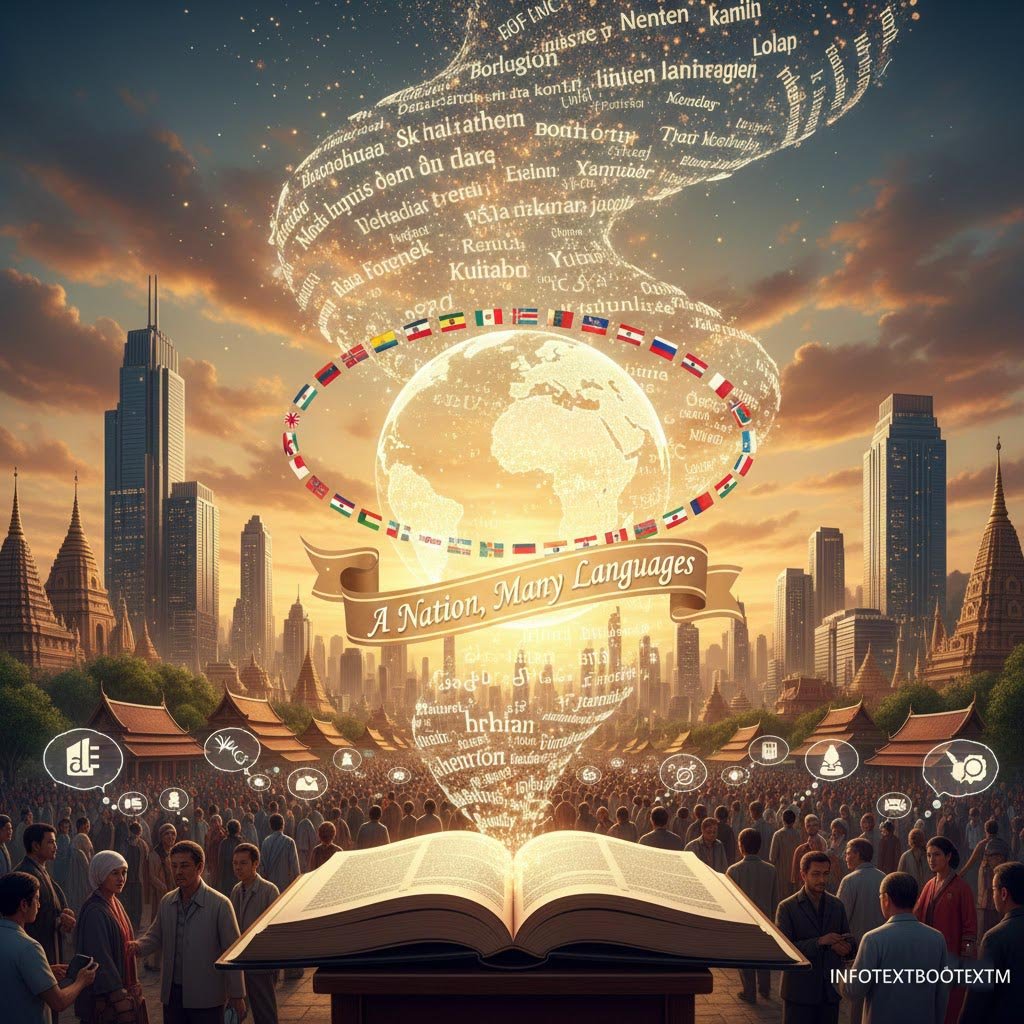
The Background: A Nation, Many Languages
When India became a republic in 1950, its leaders faced a daunting question: What should be the country’s official language? The Constitution declared Hindi in Devanagari script as the “official language of the Union,” while allowing English to continue for official use for 15 years. After 1965, English was expected to be phased out.
For large parts of northern India, Hindi was already a widely used language. But in the south especially in Tamil Nadu this decision triggered alarm. Tamil is one of the world’s oldest classical languages, with a literary history stretching back over two millennia. For many Tamils, the prospect of Hindi replacing English in administration, education, and employment looked less like national integration and more like cultural domination.
Dravidian Ideology and the Rise of Language Politics
By the 1950s, Tamil Nadu had become a stronghold of the Dravidian movement, which argued that South India’s languages and cultures were distinct from those of the north. Leaders such as Periyar E. V. Ramasamy and C. N. Annadurai (Anna) of the Dravida Munnetra Kazhagam (DMK) used language as a rallying point for broader demands of social justice, federalism, and self-respect.
To them, Hindi was not merely another Indian language it symbolized political and cultural centralization. They feared that making Hindi the sole official language would disadvantage non Hindi speakers in government jobs, education, and public life.
Why 1959 Became a Flashpoint
In 1959, the central government began pushing more actively for the wider use of Hindi in official work. This included steps to promote Hindi in central government offices and examinations. In Tamil Nadu, these moves were seen as a preview of what would happen in 1965 when English was scheduled to end.
The DMK seized the moment. It announced statewide protests against Hindi imposition, calling on students, workers, and the general public to defend Tamil language rights.
What followed was one of the most intense political mobilizations in the state’s history.
Protests on the Streets
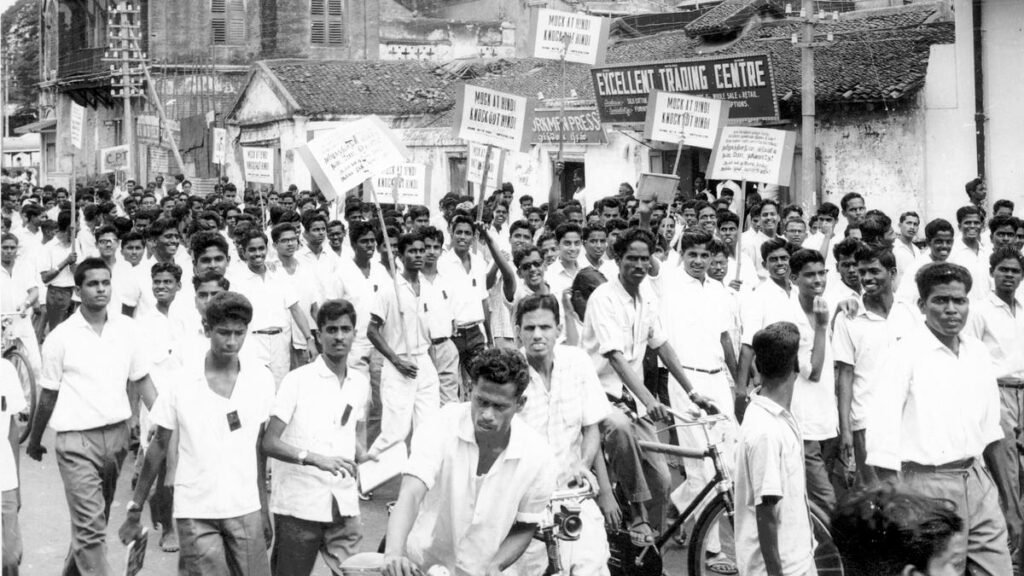
Throughout 1959, protests erupted across Madras State (as Tamil Nadu was then known). Demonstrators marched through towns and cities, held public meetings, and staged sit-ins. Students formed a large part of the movement, seeing their future opportunities at risk.
Slogans such as “Down with Hindi imposition” and “Long live Tamil” echoed through streets and campuses. The movement was not anti Hindi as a language, its leaders insisted, but against the idea of Hindi being forced on non Hindi speakers.
The government, led by the Indian National Congress at the time, responded with arrests and restrictions on public gatherings. Many DMK leaders, including Annadurai, were jailed. But instead of weakening the agitation, these actions often strengthened public sympathy for the protesters.
A Battle of Identity
What made the 1959 protests so powerful was that they were not just about administration or exams. They touched a deeper nerve identity.
For Tamils, language is inseparable from history, literature, and pride. The idea that a northern language could become dominant in their own land felt like a threat to that heritage. Writers, poets, and scholars joined the agitation, framing it as a struggle to preserve one of the world’s great classical cultures.
The movement also connected language with social equality. Many feared that Hindi dominance would create a new elite those fluent in Hindi while marginalizing others, especially in competitive central government services.
National Impact
Although the 1959 agitation was largely confined to Tamil Nadu, it sent shockwaves to New Delhi. For the first time, the central leadership had to confront the reality that language policy could threaten national unity rather than strengthen it.
The protests made it clear that simply waiting until 1965 to impose Hindi would not resolve the issue. Southern states were watching closely, and Tamil Nadu was leading the resistance.
From 1959 to 1965
The 1959 Language War did not immediately stop Hindi promotion, but it laid the groundwork for what would come next. When 1965 arrived and the deadline to replace English with Hindi approached, Tamil Nadu once again erupted in even larger protests some of which turned violent.
Those later events are more famous, but they were built on the political and emotional foundation created in 1959.
The Turning Point: A New Language Policy
The sustained resistance from Tamil Nadu and other non-Hindi states forced the central government to rethink its approach. In 1967, Parliament passed the Official Languages Act, which guaranteed the continued use of English alongside Hindi for all official purposes of the Union, as long as non-Hindi states desired it.
This was a major victory for Tamil Nadu’s language movement. It ensured that no Indian would be disadvantaged in central government dealings simply because of their mother tongue.
How 1959 Changed Tamil Nadu Politics
The Language War also transformed state politics. The DMK, which had led the agitation, gained enormous popularity. In 1967, it defeated the Congress and formed the government in Tamil Nadu for the first time a shift that still shapes the state’s political landscape today.
Language became a permanent pillar of Tamil Nadu’s political identity. Even decades later, any hint of Hindi imposition sparks immediate debate and resistance.
A Legacy That Endures
Today, India officially recognizes 22 languages and follows a policy of linguistic federalism. English and Hindi continue as official languages of the Union, but states are free to use their own languages for administration and education.
This balance fragile yet functional owes much to the struggles of 1959. The Tamil Nadu Language War showed that unity in a diverse country cannot be built on uniformity. Respect for linguistic and cultural differences is not a weakness of India; it is one of its greatest strengths.
Why It Still Matters
In an era when questions of identity and nationalism are once again at the center of political debate, the lessons of 1959 remain relevant. The protests were not about rejecting India, but about shaping an India that could accommodate all its voices.
More than six decades later, the echoes of that struggle still resonate every time language policy is discussed in Parliament, classrooms, or on the streets of Tamil Nadu.
The 1959 Tamil Nadu Language War stands as a reminder that in India, language is not just a means of communication it is a matter of dignity, democracy, and belonging.
Final Thoughts
The 1959 Tamil Nadu Language War was not just a protest against a language it was a powerful fight for cultural identity, equality, and federal rights. It showed that a diverse country like India cannot survive on forced uniformity. Instead, it must respect and protect the many languages and cultures that make up the nation.
This historic movement helped ensure that no Indian would be disadvantaged because of their mother tongue. Even today, Tamil Nadu’s strong stand on language reminds the country that true unity comes from respecting differences, not erasing them
Frequently Asked Questions (FAQs)
Q1. What was the 1959 Tamil Nadu Language War?
The 1959 Tamil Nadu Language War was a mass protest against the central government’s efforts to promote Hindi as India’s sole official language. People in Tamil Nadu feared it would replace English and disadvantage non-Hindi speakers.
Q2. Why did Tamil Nadu oppose Hindi in 1959?
Tamil Nadu opposed Hindi because it was seen as cultural and political domination over non-Hindi states. Tamils wanted equal respect for their ancient language and feared losing opportunities in education and government jobs.
Q3. Who led the 1959 language protests?
The movement was led mainly by the Dravida Munnetra Kazhagam (DMK), with leaders like C. N. Annadurai and ideological support from Periyar E. V. Ramasamy.
Q4. Was the 1959 protest violent?
Most protests were peaceful, including marches, student movements, and public meetings. However, there were arrests and police actions, which increased public support for the movement.
Q5. How did the 1959 agitation affect India’s language policy?
It pressured the central government to reconsider its approach. It later contributed to the Official Languages Act of 1967, which allowed English to continue along with Hindi for official purposes.
Q6. How is the 1959 Language War different from the 1965 protests?
The 1959 movement laid the foundation for resistance, while the 1965 protests were larger and more intense. Both were part of the same struggle to protect linguistic rights.