Table of Contents
ToggleHow to Apply for a Russia Student Visa – Step-by-Step Guide

If you are planning to study in Russia, one of the first and most important steps is obtaining a Russia Student Visa. This visa allows international students to enter Russia for the purpose of higher education, language courses, or academic exchange programs. In this guide, you will learn everything you need to know about how to apply for a Russia Student Visa—from prerequisites and documentation to application steps and practical tips.
Whether you are a first-time applicant or renewing your permit, this article aims to help you prepare thoroughly and avoid common glitches. By the end of your reading, you’ll feel confident navigating the process of a Russia Student Visa application.
Why You Need a Russia Student Visa: Overview & Eligibility
High-level summits between India and Russia generally aim to reaffirm long-standing cooperation, strengthen diplomatic trust, and expand collaboration in multi-sector areas. When analyzing Putin in India: Strategic Agreements, it’s important to understand the broader objectives that shape such engagements.
Typical Objectives of High-Level India–Russia Summits
Review existing defence partnerships
Expand energy cooperation, including nuclear and hydrocarbons
Strengthen trade mechanisms
Enhance strategic communication on regional and global issues
Deepen cooperation in space, science, and technology
These objectives serve as the foundation for any long-term diplomatic outcome and provide a structured framework for comprehensive bilateral engagements.
Strategic Agreements – What Putin in India Usually Focuses On
This section highlights the depth and nature of cooperation typically discussed under Putin in India: Strategic Agreements, especially focusing on key policy areas.
1. Defence and Security Cooperation
India and Russia share one of the world’s longest-running defence relationships. Summits commonly review:
Joint production of defence equipment
Technology transfer agreements
Maintenance and modernization of existing platforms
Maritime security and naval cooperation
Counterterrorism strategies
These discussions help both nations maintain robust defence preparedness while diversifying technological capabilities.
2. Nuclear Energy and Civilian Atomic Collaboration
India–Russia nuclear cooperation spans decades. High-level visits often reinforce:
Expansion of civilian nuclear power projects
Joint research in new nuclear technologies
Skill development in nuclear engineering
Long-term fuel supply mechanisms
Such agreements strengthen India’s energy security and sustainable development goals.
3. Trade Agreements and Economic Roadmaps
When evaluating Putin in India, trade consistently emerges as a priority. Dialogues often include:
Targeted trade volume growth plans
Simplification of customs procedures
Cooperation in sectors like pharmaceuticals, metallurgy, and chemicals
Integration of financial payment systems for smoother trade
Enhanced agricultural exports and imports
These strategies aim to diversify trade and reduce logistical challenges.
4. Energy and Hydrocarbon Partnerships
Energy engagement is central to India–Russia relations. Summits usually address:
Long-term oil supply agreements
Collaboration in LNG transport and storage
Refinery technology partnerships
Joint exploration projects
Energy cooperation enables India to secure reliable sources while enhancing its refining capacities.
5. Science, Space & Technology Collaboration
India and Russia have a legacy of space collaboration. High-level visits may reinforce:
Satellite development partnerships
Space exploration projects
Advanced science & technology exchanges
Joint research in AI and cybersecurity
Such agreements contribute to technological modernization and innovation ecosystems.
Preparatory Steps Before the Application
Before filling out forms or scheduling appointments, take the time to prepare thoroughly. These preparatory steps will save time and avoid common mistakes.
Step 1 – Secure Admission & Enrollment Confirmation
Apply to your chosen Russian university or language school.
Once accepted, request an official invitation for study (sometimes called a visa support letter) from the institution or the Russian Ministry of Education.
Make sure this letter mentions your full name, passport number, duration of study, and program details.
Without this official invitation, visa authorities will not begin processing your application.
Step 2 – Check Passport Validity & Funds
Ensure your passport is valid for at least 18 months (or more) from your planned date of arrival.
Some embassies require applicants to show recent bank statements or scholarship proof demonstrating sufficient funds for tuition and living expenses.
Step 3 – Health & Vaccination Requirements
Depending on your country of origin, you might need:
A valid medical insurance covering your stay in Russia.
Certain vaccinations if required by Russian immigration authorities.
Possibly a health certificate or HIV test, though this varies by country and university.
Confirm these requirements with the Russian consulate or your university’s international student office.
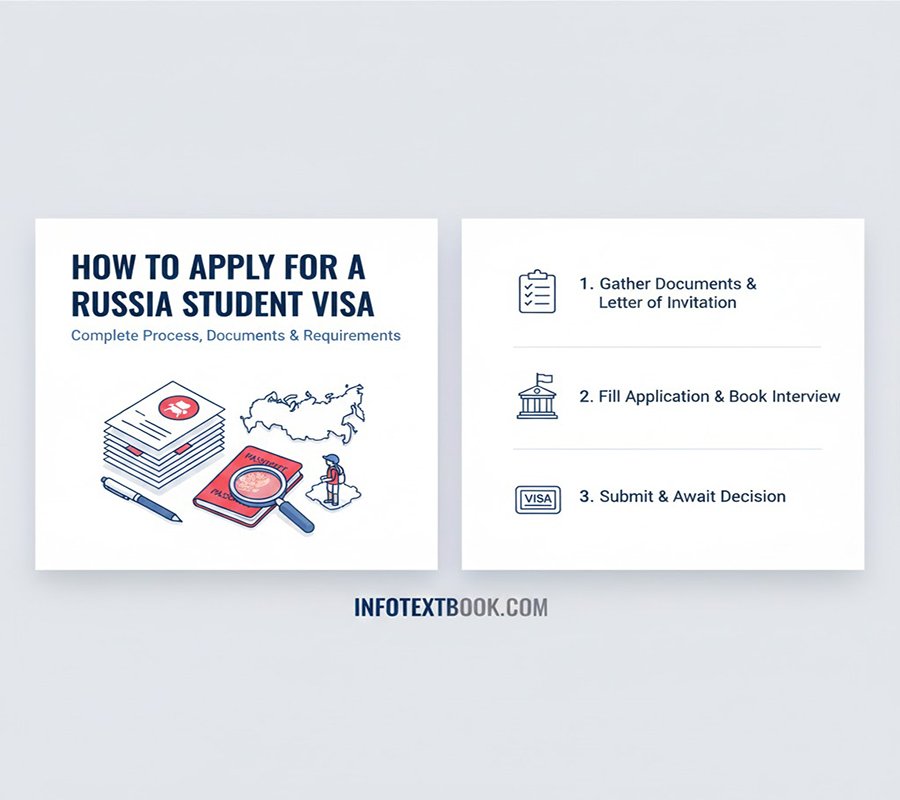
How to Apply for a Russia Student Visa – The Application Process
This section outlines the actual steps you will follow to obtain your visa. It reflects a typical procedure in many Russian embassies or consulates worldwide.
Step 1 – Complete the Visa Application Form
Begin by filling out the official visa application form, often available online via the website of the Russian consulate serving your country.
Use Latin script (as per your passport) for all fields.
Fill in your full name, date of birth, passport number, purpose of visit (“education/study”), period of stay, and details of the inviting institution.
Double-check all entries for typos—errors may lead to refusal.
Many embassies allow digital application submission, while some still require a printed, signed form.
Step 2 – Gather Required Documents
Prepare a file containing the following standard documents:
Original passport with at least two blank pages and valid for at least 18 months.
Photocopy of passport’s information page.
Passport-sized photographs (usually 2–4, according to embassy specifications).
The official invitation letter / visa support letter / enrollment confirmation from the Russian institution.
Completed visa application form.
Proof of funds or scholarship documents / bank statement / financial guarantee.
Health insurance valid in Russia for the duration of your stay.
Any required medical certificates, immunization records, or test results, if applicable.
A self-addressed and prepaid envelope or pickup slip, if using mail-in service (depending on the embassy).
Step 3 – Pay Visa Fees and Schedule Appointment (If Required)
Most embassies charge a non-refundable visa processing fee. The amount and payment method vary by country.
Pay the fee as per the consulate’s instructions (online, bank transfer, or cash).
If required, schedule an in-person visa appointment at the consulate or visa center. Bring all original documents and copies.
Step 4 – Submit Application and Attend Interview (If Called)
At your appointment or visa center:
Submit the full application package.
Offer original documents plus photocopies.
Some consulates may conduct a brief interview—questions typically address your intent to study, duration, and financial capacity.
Expect to provide biometric data (fingerprints/photo), although many Russian embassies have waived fingerprinting requirements for older or certain categories of applicants; check in advance.
Step 5 – Wait for Processing and Collect Visa
Processing time may vary: from 7–30 days depending on the embassy, time of year, and caseload.
Once approved:
You’ll receive a visa sticker in your passport, stating “Study” or “Education” as purpose, along with validity dates.
Check the spelling of your name, passport number, and validity period carefully.
If using mail-in, track your return envelope or courier.
Congratulations—you now have a valid Russia Student Visa!
After Arrival in Russia – What You Must Do
Obtaining the visa is only the first step. Once you arrive, there are additional formalities you need to complete promptly.
Step 1 – Register with Local Authorities
Within 7 working days of arrival (sometimes 5–10 days depending on region), international students must register their place of residence.
Most universities assist international students with this process.
You may need to submit a copy of your passport, visa, and migration card to local immigration (or the university’s international office).
Registration will be valid for the duration of your course, but you may need periodic updates if you change city or address.
Failing to register can lead to fines or visa cancellation.
Step 2 – Convert to Residence Permit (Optional / Where Required)
For long-term study (e.g., multi-year degrees), some students choose or are required to apply for a temporary residence permit or student residence permit.
This process involves:
Application via the migration authorities (or university support office).
Submission of passport, visa, registration certificate, and possibly proof of funds or insurance.
Some regions may request local address proof, photos, and biometric data.
Residence permits make travel within Russia easier and allow more stability, but vary by region—check your university’s guidance.
Step 3 – Adhere to Visa Rules & Regulations
Don’t overstay beyond the date on your visa.
Update your registration if you change cities or residences.
Notify authorities if your course duration changes or if you plan to leave Russia permanently.
Maintaining compliance ensures a smooth stay and future visa renewals.
Common Mistakes to Avoid When You Apply for a Russia Student Visa
When applying or traveling on a Russia Student Visa, many applicants make avoidable mistakes. Here are common pitfalls and how to prevent them:
Submitting an invalid or expired passport — always ensure passport validity is at least 18 months ahead.
Using an unofficial invitation letter — only accept letters issued by recognized institutions or approved bodies.
Poor-quality photos or missing photo requirements — follow embassy specifications strictly.
Incomplete application form or missing signatures — double-check every detail before submission.
Not scheduling or missing the biometric appointment — confirm if your embassy requires fingerprints or photos.
Delayed registration after arrival — set a reminder to complete local registration within the required period.
Ignoring visa validity dates — check both entry and exit dates on the visa sticker.
Not carrying health insurance or vaccination proofs — keep valid documents accessible while traveling.
Avoiding these mistakes will increase your chances of approval and smooth entry.
Tips & Practical Advice for International Students
To maximize your experience and avoid hassles while studying in Russia, consider these practical tips:
1. Start Early
Begin the process 3–4 months before the course start date. Invitation letters may take weeks, and visa processing may face delays during peak seasons.
2. Keep Multiple Sets of Copies
Scan and print duplicates of all documents—passport, visa, enrollment letter, insurance, and registration. Store digital backups in cloud storage.
3. Understand Language & Cultural Differences
Many forms and official letters may be in Russian. Ask your university’s international office for translations or assistance.
4. Stay Informed About Local Laws
Russian visa and immigration laws can change. Follow updates via official embassy or consulate notices, or through your university’s international student support office.
5. Budget Realistically
Apart from tuition, consider costs for living, health insurance, travel, registration, residence permit if needed, and personal needs. Having a buffer helps.
Sample Timeline – How Long the Entire Process Takes
Here’s a realistic timeline from acceptance to finalizing your stay under a Russia Student Visa:
| Phase | Approximate Duration |
|---|---|
| Admission & receipt of invitation letter | 2–6 weeks |
| Preparing documents & visa application | 1–2 weeks |
| Visa processing by consulate | 1–4 weeks (varies by embassy/workload) |
| Travel & arrival in Russia | Dependent on your plan |
| Local registration after arrival | Within 5–10 working days |
| (Optional) Residence permit application | Additional 2–4 weeks after registration |
This helps you plan your travel and academic plans well in advance.
Who to Contact for Help & Where to Verify Information
When applying for a Russia Student Visa, relying on credible sources is important. Reach out to:
The international students’ office of your admitting Russian university.
The Russian embassy or consulate in your home country or its designated visa center.
Official immigration authorities in Russia, especially after arrival.
Events or forums of international student communities – they often share practical tips and recent experiences.
Always verify information from official sources—not social media rumors—to avoid errors or scams.
Conclusion
Obtaining a Russia Student Visa is a critical step on your journey toward studying in a Russian university. From securing your invitation letter and filling the visa application to registering once you arrive, every stage requires careful attention. By following this comprehensive guide, you can streamline the process and avoid common pitfalls.
Remember: start early, prepare complete documentation, follow regulations, and stay informed. With the correct approach, you will successfully complete the steps to apply for a Russia Student Visa, begin your educational journey in Russia, and focus on what matters most—your studies and personal growth.
Best of luck on your academic adventure abroad!
Frequently Asked Questions (FAQs)
Q1: What is the validity period of a Russia Student Visa?
A Russia Student Visa is generally valid for the duration of your academic program, up to a maximum specified by the issuing authority. For full-time degree courses, it typically covers one academic year, with extensions possible upon renewal.
Q2: Can I travel outside Russia on a student visa and return?
Yes — you can travel outside Russia and return as long as your Russia Student Visa and registration are valid, and you carry required documents like your passport, visa, registration certificate, and admission letter.
Q3: Do I need health insurance to apply for a Russia Student Visa?
Most Russian embassies or institutions require valid health insurance covering your stay. It is often mandatory both during visa application and while residing in Russia.
Q4: Can I work part-time while studying on a Russia Student Visa?
Work permissions depend on the region and rules of the university. Some institutions allow part-time work for international students on a valid student visa, but you must verify with your university’s regulations.
Q5: What happens if I miss registering within the required period after arrival?
Failing to register with local authorities as required can lead to penalties, fines, or even cancellation of your visa status. Always complete registration within 5–10 working days of arrival.